Choosing furniture often begins with a simple question: What is the difference between solid wood and MDF furniture? The answer affects durability, appearance, moisture resistance, cost, and repairability. It also changes how a cabinet feels when you open its door.
Solid wood comes from sawn timber, showing natural grain, knots, and seasonal movement. MDF uses refined wood fibers, wax, and resin compressed into dense panels. The U.S. Forest Products Laboratory explains that wood responds to moisture, expanding and shrinking as humidity changes. That detail matters beside kitchens, bathrooms, and sunny windows. MDF usually offers a smoother, more consistent surface for paint. However, damaged edges can swell when water reaches the core.
Paul Sellers, a respected woodworking educator, describes MDF as “a very stable material.” That stability supports accurate shelving and painted furniture. Still, stability does not mean invincibility. Screws require careful placement, and repeated assembly may weaken MDF faster than hardwood. The U.S. Environmental Protection Agency also identifies MDF as a regulated composite wood product under TSCA Title VI, which addresses formaldehyde emissions. Certified products and adequate ventilation remain sensible choices.
Industry market reports, including analyses from Grand View Research, continue to show strong demand for engineered wood furniture because it balances affordability and design flexibility. Yet market popularity cannot decide your room’s needs. A heavy oak table may last decades, while a well-made MDF wardrobe may better suit a dry bedroom and limited budget.
The following seven tips compare both materials honestly. Some conclusions are uncomfortable. The cheapest option may cost more after repairs, but expensive solid wood is not automatically better.
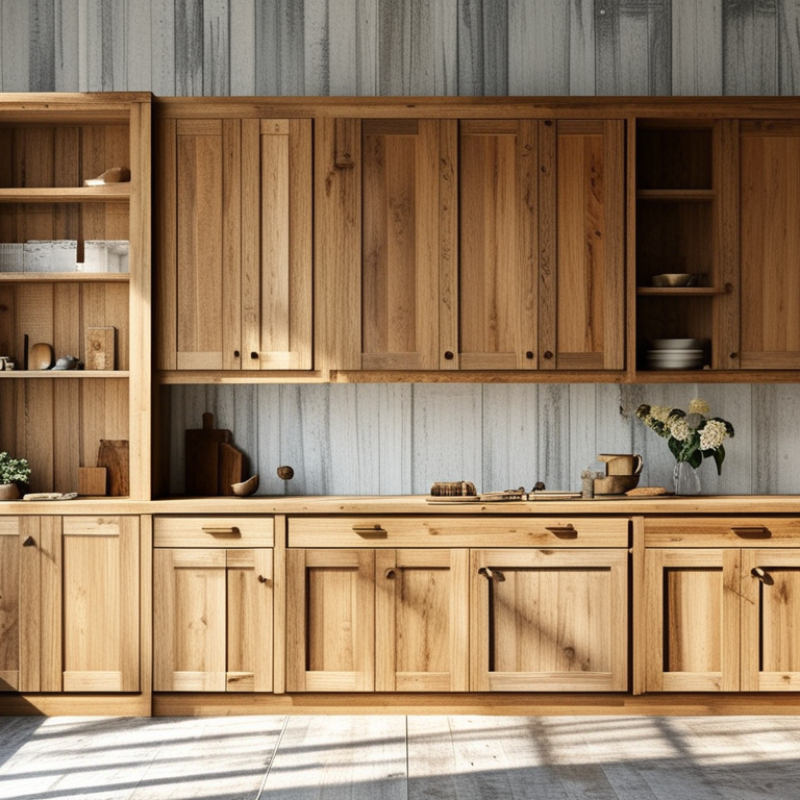
MDF and solid wood do not start with the same physical profile.
Industry technical data commonly places medium-density fibreboard between 600 and 800 kg/m³. Its refined wood fibres create a fairly uniform panel, so a cabinet side feels consistent from edge to edge. That uniformity helps machining and reduces surprises during production.
Solid wood is more variable. The USDA Forest Products Laboratory’s Wood Handbook reports large differences in wood density among species, from very light woods below 400 kg/m³ to dense species above 900 kg/m³. Moisture also matters. A board’s weight, movement, and hardness can change after installation.
Material behaviour Oak may feel firm and heavy, while pine feels lighter and dents more easily. Same category, different behaviour.
In practical furniture work, MDF often gives smooth painted surfaces and stable dimensions. Solid wood offers visible grain, repair potential, and a warmer tactile response. However, MDF edges need careful sealing, especially near water. Solid wood needs room to expand and contract.
I have seen installers blame “poor material” when the real problem was trapped moisture or weak edge support.
Density alone cannot decide quality. It is only one measurement, not the whole furniture story. Industry panel specifications from the European Panel Federation also show that MDF grades vary by intended use, so comparing density without thickness, bonding quality, and moisture resistance can lead to a careless decision.
Seven practical tips can make this comparison fairer. Start with matching panels by thickness, width, and moisture condition. Moisture changes stiffness and can distort results.
In workshop testing, I would condition every sample indoors before cutting. Use the relevant ASTM D1037 bending procedure for wood-based panels, then record load, deflection, and failure location.
Test solid wood with the grain direction clearly marked. MDF has no grain, but its face and edge behave differently. Small samples can produce misleading results.
For screw-holding performance, use identical screw sizes, pilot holes, insertion depths, and edge distances. Measure withdrawal force separately from the face and edge.
A screw may grip MDF’s dense face well but fail quickly near an edge. Solid wood often carries higher withdrawal loads, yet knots, splits, and grain direction create uneven results.
Repeat each test several times and report the average with the lowest value. Do not judge furniture from bending strength alone. Joints, fasteners, humidity, and unsupported spans matter in real use.
A heavier panel is not automatically stronger. My own comparisons have shown that MDF can feel stable under evenly distributed weight, while solid wood usually performs better under concentrated loads and repeated fastening.
The imperfect part is obvious: laboratory results cannot fully reproduce careless assembly or years of movement.
Moisture performance often decides whether solid wood or MDF furniture ages gracefully. The USDA Forest Products Laboratory’s Wood Handbook (2021) explains that wood responds continuously to surrounding humidity.
A calibrated moisture meter should read several areas, including board edges and concealed surfaces. Solid wood can absorb moisture unevenly, causing cupped doors, open joints, or tight drawers. MDF is more uniform, but exposed edges can swell quickly after contact with water. The European standard EN 622-1 sets moisture-content requirements for fibreboards, yet ordinary MDF remains unsuitable for persistent dampness. Moisture-resistant grades need separate verification.
Sealing MDF edges helps, although it is not waterproofing. The 6–8% target is useful, but not sacred; local climate, heating patterns, and room humidity can shift the correct reading. A single meter reading is never proof.
Solid wood and MDF differ most in adhesive content, not appearance. Solid wood usually contains no composite core, while MDF relies on resin-bonded fibers. That resin can release formaldehyde indoors. The EPA TSCA Title VI limits are specific: 0.05 ppm for hardwood plywood, 0.09 ppm for particleboard, and 0.11 ppm for MDF. Thin MDF has a 0.13 ppm limit.
Check the paperwork.
A compliant furniture supplier should provide a TSCA Title VI certificate, panel identification, and testing records from an approved third-party certifier. The paperwork should match the actual panel, thickness, and production batch. A generic “low-emission” claim proves very little. EPA compliance documents are more useful than attractive showroom language. The EPA also requires regulated composite wood products to carry compliance information through the supply chain.
Room conditions matter too. The World Health Organization’s Guidelines for Indoor Air Quality: Formaldehyde recommends 0.1 mg/m³ for a 30-minute average. Warm, humid rooms can increase emissions from newly manufactured MDF furniture. Open drawers and air the room before regular use. A simple smell test is unreliable. Formaldehyde may be present without a strong odor.
In practice, solid wood is not automatically safer. Paints, coatings, adhesives, and hidden MDF back panels still require checking. I would inspect every panel, not just the visible frame. That takes longer. It also prevents a common mistake: trusting the material label while ignoring the cabinet’s actual components.
| Comparison Dimension | Solid Wood Furniture | MDF Furniture | Practical Buying or Compliance Tip |
|---|---|---|---|
| 1. Basic Material Structure | Boards made primarily from natural wood. A finished product may still include plywood, particleboard, MDF, adhesives, coatings, or edge components. | Engineered wood panel made from refined wood fibers bonded with resin under heat and pressure. | Check every panel and hidden component rather than judging the entire item only by its outer veneer or finish. |
| 2. Typical Strength and Service Life | Generally strong, repairable, and capable of long service when properly dried, joined, and protected from excessive moisture. | Provides a uniform, smooth panel surface and good dimensional consistency. It is less tolerant of prolonged water exposure and damaged edges. | Best choice depends on use Solid wood is often preferred for heavily stressed or repairable parts; MDF works well for stable painted panels and shaped components. |
| 3. Moisture Resistance | Moisture performance varies by wood species, construction, sealant, and joint design. Wood can swell, shrink, or warp as humidity changes. | Standard MDF can swell when exposed to water, especially at cut edges. Moisture-resistant grades are not automatically waterproof. | For kitchens, bathrooms, or humid locations, verify the panel grade, edge sealing, and installation conditions. |
| 4. Formaldehyde Source | Natural wood itself is not a composite wood panel regulated by TSCA Title VI. However, adhesives, coatings, engineered inserts, or other composite components may contribute emissions. | Formaldehyde may be emitted from the resin used to bond wood fibers. Emissions vary by resin technology, panel construction, age, temperature, and humidity. | Ask for documentation covering the actual composite wood components used in the furniture, not only a general material description. |
| 5. TSCA Title VI Applicability | Usually outside panel limits Solid wood is not classified as hardwood plywood, MDF, thin MDF, or particleboard. A product can still contain regulated composite wood parts. |
Regulated composite wood MDF is specifically covered by TSCA Title VI. Thin MDF is treated as a separate regulated panel category. |
Finished goods containing regulated composite wood must use compliant panels and meet applicable import, labeling, recordkeeping, or certification requirements. |
| 6. EPA TSCA Title VI Emission Limits | No TSCA Title VI composite-panel emission limit applies to solid wood itself. | MDF: maximum 0.11 ppm formaldehyde. Thin MDF: maximum 0.13 ppm formaldehyde. These are chamber-test emission limits, not a formaldehyde concentration for the entire room. |
For a compliance review, confirm the component category and obtain test or certification records tied to the relevant panel type and production period. |
| 7. Verification Checklist | Identify all engineered-wood parts; review adhesives and finishes; confirm whether any regulated composite wood is present. | Confirm whether the panel is MDF or thin MDF; check the applicable emission result; verify compliant labeling or supplier documentation where required. | Recommended evidence Material specification, panel category, test report or certification record, supplier declaration, production date, and finished-product documentation. |
| Overall Assessment | Advantages: natural appearance, repairability, and strong structural potential. Limitations: variable movement, higher maintenance needs, and possible hidden composite components. |
Advantages: smooth finish, consistent dimensions, efficient use of wood fiber, and good suitability for painted furniture. Limitations: moisture sensitivity and potential formaldehyde emissions from resin-bonded fibers. |
Neither is automatically better Select based on structural needs, moisture exposure, finish requirements, component transparency, and verified formaldehyde compliance. |
Judge value through construction, not labels. Solid wood can be sanded, rejoined, and refinished after years of use. MDF offers a smooth, stable panel for dry interiors, but swollen edges rarely recover after water exposure. Look closely. Check joint strength, panel thickness, veneer quality, and replaceable hardware. USDA Forest Products Laboratory’s Wood Handbook explains that moisture control is central to wood durability. A solid-wood frame still fails when water repeatedly reaches its joints.
Repairability changes the calculation. Ask whether doors, legs, drawer runners, and fasteners can be replaced without destroying the panel. A repair shop often sees loose joints restored quickly, while damaged MDF corners require cutting, filling, and repainting. That is not always a deal-breaker. MDF may use wood fibers efficiently, and its performance can suit a stable bedroom or office. My own judgment would remain cautious around bathrooms, kitchens, and unsealed floors.
Read the EPD, not just the green claim. A product-specific, third-party-verified EPD follows ISO 14025 and reports impacts such as global warming potential. Compare declared units, service-life assumptions, and replacement cycles. The UNEP Global Resources Outlook 2024 reports that global resource extraction has tripled over five decades and could rise another 60% by 2060. The U.S. EPA’s municipal solid waste data also estimated about 12.1 million tons of furniture and furnishings were generated in 2018, with roughly 80% landfilled. Life-cycle data can expose a cheaper item that needs two replacements. Durability remains difficult to predict. Ask better questions.
: Match panel thickness, width, moisture condition, and unsupported span. Condition samples indoors before cutting. Small samples may distort the comparison.
Use a recognized wood-panel bending procedure. Record load, deflection, and failure location. Mark solid wood grain direction clearly. MDF has no grain, but its face and edge behave differently.
Solid wood usually performs better under concentrated loads. MDF can feel stable under evenly distributed weight. Load placement matters.
No. Weight alone proves little. Joints, fasteners, humidity, and unsupported spans affect performance. A heavy panel can still fail at a weak joint.
Use identical screw sizes, pilot holes, insertion depths, and edge distances. Measure face and edge withdrawal separately. Repeat each test several times.
MDF may grip screws well through its dense face. Its edge can lose holding strength quickly. Solid wood often holds more strongly, but knots and splits create uneven results.
Request a compliance certificate, panel identification, and approved third-party test records. The documents should match the panel thickness and production batch. Generic claims are weak evidence.
A US composite-wood regulation sets 0.11 parts per million for MDF. Thin MDF may have a 0.13 limit. Other panel types have different limits. Check the applicable category.
Yes. Warm, humid rooms can increase emissions from newly manufactured MDF furniture. Open drawers and ventilate the room. Smell is unreliable.
No. Testing cannot fully reproduce careless assembly or years of movement. This comparison is imperfect. Inspect hidden back panels, coatings, adhesives, and fasteners too.
Choosing between solid wood and MDF furniture depends on performance, environment, and long-term value. What is the difference between solid wood and MDF furniture? MDF is an engineered panel made from refined wood fibers, typically with a density of about 600–800 kg/m³, while solid wood varies considerably by species, grain, and moisture content. Solid wood often provides greater structural strength and repairability, but well-made MDF can offer excellent dimensional stability and a smooth, consistent surface. ASTM D1037 bending and screw-holding tests can help compare load capacity and fastener performance rather than relying on appearance alone.
Moisture control is also important: interior solid wood should generally reach a moisture content of about 6–8% before use, while both materials require protection from prolonged humidity or water exposure. Buyers should verify that MDF products meet EPA TSCA Title VI formaldehyde limits. Finally, value should be judged through expected durability, ease of repair, environmental product declarations, and available life-cycle data, not only the initial purchase price.

TayLord Furniture